Saami Activist Valentina Sovkina Speaks at the European Parliament on Repression Against Indigenous Peoples in Russia

Updated: 6 days ago

Brussels, March 3, 2026. A public dialogue titled “Voices of Indigenous Peoples against Russia’s Repression” was held at the European Parliament to discuss the situation of Indigenous Peoples’ rights in Russia. The event was organized by Lithuanian Member of the European Parliament Rasa Jukneviciene in cooperation with the human rights organization Anti-Discrimination Centre Memorial.
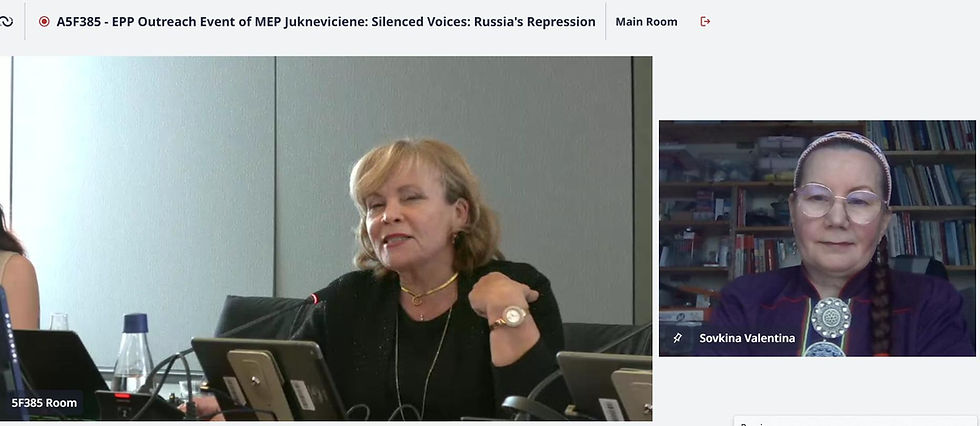
The meeting brought together representatives of Indigenous Peoples, human rights defenders, researchers, and civil society activists to discuss the growing repression against activists working to protect Indigenous rights in Russia.
One of the key contributions came from Saami activist Valentina Sovkina, who addressed the event remotely.
Sovkina began her remarks by emphasizing the deep connection Indigenous Peoples have with their traditional territories.
“I am Saami by birth. My ancestors lived on land without borders, freely moving across Sápmi. Each of us has our own land — the place where our roots begin,” she said.
In her speech, the activist stressed that discussions about Indigenous rights must be grounded in international standards, particularly the United Nations Declaration on the Rights of Indigenous Peoples and the ILO Convention No. 169.
According to Sovkina, states cannot apply international law selectively.
“International law is not a menu. You cannot recognize cultural rights while ignoring land rights. You cannot speak about participation while excluding Indigenous Peoples from decision-making,” she said.
She also recalled the words of UN Secretary-General António Guterres that international law and human rights cannot be applied selectively.
A significant part of her speech focused on recent developments in Russia. Sovkina noted that in December 2025, searches, detentions, and arrests of Indigenous activists took place in several regions of the country. Many of those targeted had been engaged in environmental, cultural, and human rights activities.
According to her, these developments demonstrate growing pressure on civil society and on Indigenous activists defending the rights of their communities.
“Self-organization is increasingly interpreted as disloyalty, and appeals to international mechanisms are portrayed as hostile actions,” she said.
Sovkina warned that such policies could have long-term consequences.
In her view, fear and repression force people into silence while unresolved problems continue to accumulate.
“Suppressing participation does not solve problems — it only pushes them deeper,” she emphasized.
The activist also highlighted that Indigenous Peoples possess unique knowledge about their territories and ecosystems, developed over generations of living on their lands. Excluding them from decision-making processes, she said, risks creating environmental and social crises.

In conclusion, Sovkina called on the international community to pay attention to the fate of detained activists, including Daria Egereva, who remains under arrest in Russia.
She encouraged support for the international solidarity campaign Free Daria, in which people around the world record short videos calling for the activist’s release.
“Sometimes support requires very little — just a few seconds to say: Free Daria,” she said.
Participants in the dialogue at the European Parliament — including civil society representatives, researchers, human rights defenders, and Indigenous representatives — expressed solidarity with activists facing persecution and called for respect for international standards protecting the rights of Indigenous Peoples.
Free Daria!

Comments