Indigenous Voices from Russia Heard in the European Parliament

Sevr Nuu
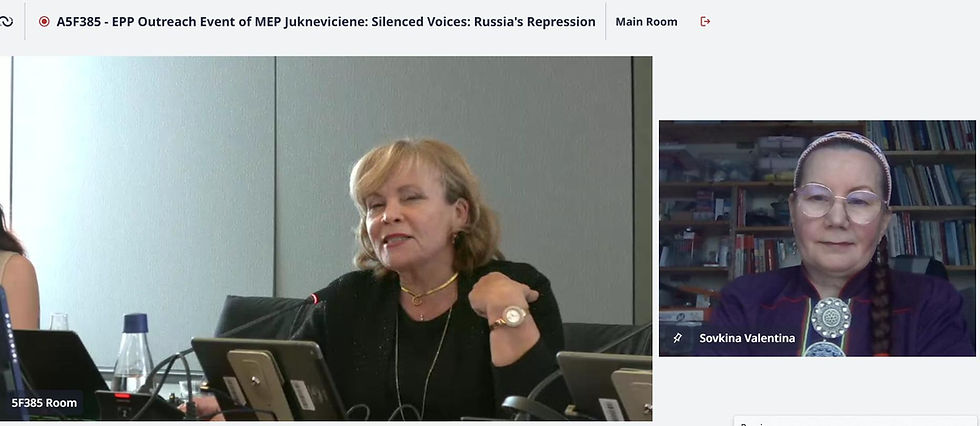
An event hosted by Member of the European Parliament Rasa Jukneviciene took place in the European Parliament in Brussels — an EPP Outreach Event entitled “Silenced Voices: Russia’s Repressions”, organized in cooperation with Anti-Discrimination Centre Memorial (ADC Memorial). This was the second meeting in this format. The first focused on Indigenous rights, environmental issues, and the preservation of traditional ways of life and culture. The current meeting addressed repression.
Opening the event, Rasa Jukneviciene welcomed the participants and briefly outlined the historical context, describing Russia as the last colonial country in Europe where pressure on Indigenous peoples continues. She then gave the floor to ADC Memorial representative Stefania Kulaeva.
Kulaeva emphasized that the purpose of the meeting was to name names, document facts, and give a platform to those whose voices are being silenced. The event began with a film by ADC Memorial bringing together seemingly unrelated events from different years: the occupation of Crimea and repression against the Crimean Tatar people; the “Baymak case” in Bashkortostan — an environmental protest suppressed by security forces; and the searches and arrests of Indigenous human rights defenders from the small-numbered peoples of the North in December 2025.
These events share one common element — the Kremlin’s effort to suppress independent Indigenous voices.

Following the film, Eskender Bariev, head of the Crimean Tatar Resource Center, delivered an analytical presentation. He presented data illustrating the scale of repression against his people. According to him, the Mejlis of the Crimean Tatar People became the first Indigenous representative body to be labeled “extremist” and banned by Russia. He stated that 340 people are currently political prisoners.

Valentina Sovkina, a representative of the Sámi people and member of the United Nations Permanent Forum on Indigenous Issues, stressed that international norms are not a “menu” from which states may select convenient provisions, but a comprehensive system of obligations. The right to self-determination, connection to land, and participation in decision-making were described as foundations of stability rather than threats to the state.

Special attention was given to the events of December 2025, when coordinated searches, detentions, and arrests of Indigenous representatives took place across several Russian regions. These actions were characterized as intimidation for peaceful environmental and human rights advocacy. According to the speaker, peaceful defense of rights is increasingly framed as a security threat, leading to silence and the erosion of trust.
In her speech, Sovkina called for the creation of safe channels for dialogue, genuine participation of Indigenous peoples in decision-making, and consistent implementation of international standards.

The international solidarity campaign “Free Daria!” was also highlighted during the meeting.

Ruslan Valiev spoke about the colonial history of Bashkortostan, recalling that the subjugation of Bashkir lands began in the era of Ivan the Terrible. The Bashkir people rose up five times against conquest. He also addressed the “Baymak case,” when more than five thousand people took to the streets to defend their native environment, followed by crackdowns, criminal prosecutions, and prison sentences.
Concluding the event, Stefania Kulaeva underlined the importance of having spoken the names and told the stories. “No one and nothing should be forgotten.” The meeting ended with a discussion and questions from the audience.

Within the walls of the European Parliament, the voices of those being forced into silence were heard once again. And as long as these voices continue to be heard, the struggle for Indigenous peoples’ right to be listened to continues.
Free Daria!


Comments