Who Speaks for Indigenous Peoples at COP17? Russia, RAIPON and Control over Representation


As the UN Biodiversity Conference in Yerevan debates Indigenous participation, a fundamental question is at stake: who chooses Indigenous representatives—the peoples themselves, or the governments whose policies those representatives must be free to criticize?
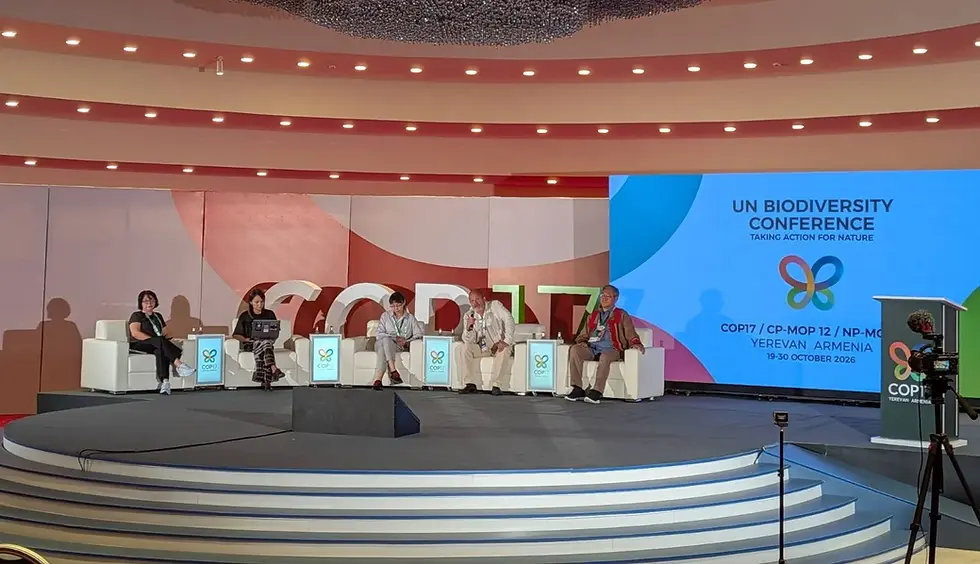
At COP17, this question has a concrete focus. According to Indigenous Russia, the Russian delegation opposed extending the system of seven Indigenous sociocultural regions across all mechanisms of the Convention on Biological Diversity. Independent Indigenous representatives defended that approach.
Behind the procedural dispute lies a question of influence: who sets the conditions for participation, and how independent can the voices heard on an international platform remain?
For Daria Egereva and Natalia Leongardt, this is no abstract debate. Both spent years helping Indigenous Peoples participate in international processes. Today, they remain in detention in Russia, while discussions that would benefit from their experience take place without them.
Why the Structure of Representation Matters
The five UN regional groups bring together states. The seven Indigenous sociocultural regions reflect a different principle: the self-organization of peoples whose historical territories, cultures and relationships extend beyond state borders.
The choice between these approaches is therefore not merely technical. If Indigenous participation becomes more closely tied to intergovernmental structures, states may gain additional opportunities to influence who speaks and which positions are represented.
Independent activists who raise concerns about extractive industries, loss of access to traditional territories or the persecution of human rights defenders are particularly vulnerable. Their work requires the freedom to criticize their own government.
The presence of Indigenous delegates at a conference does not, by itself, guarantee independent representation.
What the ICIPR Investigation Shows
A new report by the International Committee of Indigenous Peoples of Russia (ICIPR), “RAIPON Unmasked: From Indigenous Advocacy to International Statecraft,” places the COP17 dispute in a wider context.
The authors examine RAIPON’s transformation from an independent Indigenous rights organization into a structure linked to the promotion of state interests internationally. The report considers the association’s relationships with state agencies and business, its international activities and delegate training through the School of Indigenous Diplomacy.
These are the report authors’ findings and assessments. For COP17 participants, they raise an important question: what relationships and commitments stand behind organizations speaking on behalf of Indigenous Peoples?
Novyukhov Invokes the UN Declaration. What Does It Protect?
In his statement of 28 January 2026, RAIPON president Alexander Novyukhov opposed the criminalization of human rights work. At the same time, he said the association could not defend people suspected of links with organizations designated extremist and acting against the Russian state. He also disputed the representative mandate of independent activists abroad and urged international supporters to await the investigation and court decisions.
Novyukhov invokes the UN Declaration on the Rights of Indigenous Peoples in his statement. Yet Article 18 of that same Declaration affirms Indigenous Peoples’ right to participate in decisions affecting them through representatives chosen by themselves, according to their own procedures.
This raises a fundamental question: how does challenging the legitimacy of independent activists accord with Indigenous Peoples’ right to choose their own representatives?
A position that makes the willingness to defend a human rights advocate dependent on state accusations also deserves scrutiny. It allows the authorities’ allegations to define the boundaries of solidarity before responsibility has been established by a court.
The State, the Association and an Extractive Company
RAIPON’s relationship with state institutions is formally documented. The Federal Agency for Ethnic Affairs (FADN) announced a tripartite agreement with RAIPON and Nornickel, signed on 9 December 2025 by agency head Igor Barinov, Alexander Novyukhov and a company vice-president.
Cooperation alone does not prove that every representative acts under instructions from the state or business. But it makes independence a necessary question: can people participating in such relationships freely challenge decisions by state agencies and industrial companies affecting their communities?
Support for international participation should expand Indigenous Peoples’ opportunities. When access depends on political acceptability, there is a risk of selecting convenient voices and sidelining critical ones.
A Large Delegation Cannot Substitute for a Diversity of Voices
RAIPON’s official announcement describes a 16-member delegation to COP17. It includes association president and Russian senator Alexander Novyukhov, representatives of eight regional organizations, Indigenous rights commissioners and experts.
Such a delegation ensures a presence at the conference. Its size does not establish whether independent positions are represented or whether participants can speak openly about violations within Russia.
Daria Egereva helped coordinate Indigenous participation in international climate negotiations and contributed to biodiversity work. Natalia Leongardt provided organizational and practical support that enabled other human rights defenders to participate in international processes.
Their absence shows why formal participation is not enough. International platforms can welcome substantial official delegations while people who sustained independent participation remain in detention.
From COP17 to COP31
This question will remain relevant at COP31, which takes place in Antalya on 9–20 November 2026.
The climate process already distinguishes state representation from Indigenous representation. In the Facilitative Working Group of the Local Communities and Indigenous Peoples Platform, Indigenous representatives are appointed through their own focal points, separately from government appointments. The UNFCCC describes that arrangement here.
For participants in both conferences, a common principle matters: states should not be able to replace Indigenous Peoples’ own choice with the political selection of acceptable representatives.
The right to participate means the right to choose one’s representatives, speak independently and criticize those in power without fear of persecution.
As long as Daria Egereva and Natalia Leongardt remain in detention, the question of whose voices the UN hears cannot be separated from the question of whose voices have been deprived of their freedom.

Comments