When the Protection of Indigenous Peoples’ Rights Becomes a Security Issue

Updated: Oct 3

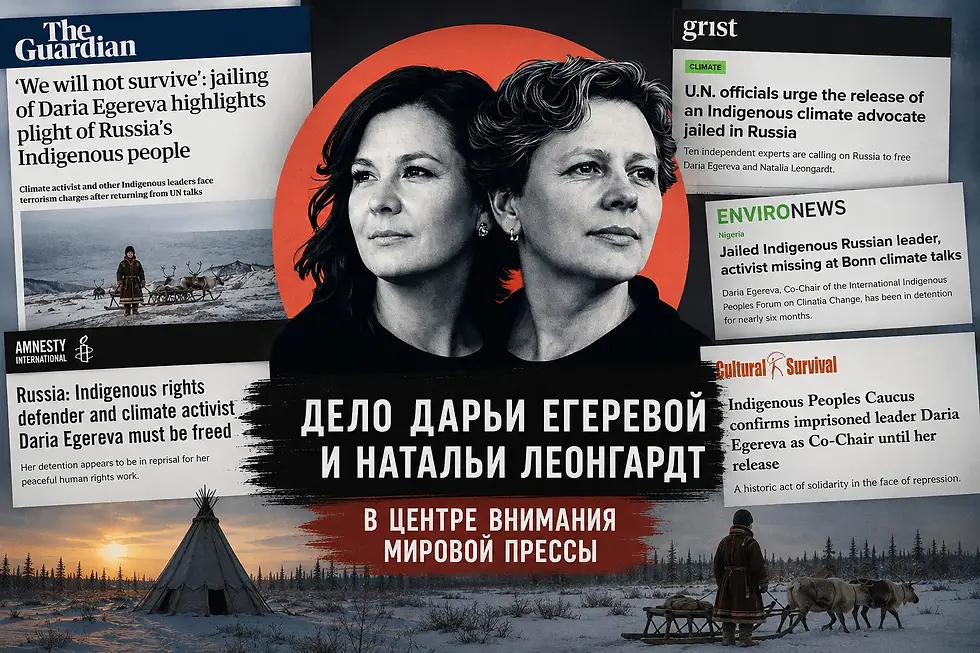
The German publication Berliner Gazette has published an analytical article by Regzena Erdyneeva on repression against Indigenous Peoples and their human rights defenders in Russia. The editors of daria-egereva.org present a review of the article.
In December 2025, human rights defenders Daria Egereva and Natalia Leongardt were arrested. Both face prison sentences of up to 20 years. In May 2026, two more arrests drew attention: environmental activist Aruna Arna from the Altai Republic and Rafael Mamedov from Murmansk.
In her article, Regzena Erdyneeva asks why issues of cultural identity, Indigenous Peoples’ rights and the economic relationship between Russia’s centre and its regions are increasingly being treated as matters of state “security.”
From human rights work to terrorism charges
The author emphasizes that the cases of Egereva, Leongardt, Arna and Mamedov are not primarily about party politics, demands for a change of government or even open criticism of Russia’s war against Ukraine. Instead, they concern cultural identity, Indigenous rights and the economic relationship between the centre and the periphery.
Berliner Gazette points to a striking paradox: “Neither Daria Yegereva nor Natalia Leonhardt nor Aruna Arna presented themselves as separatists.”
The article also notes that Rafael Mamedov was not a conventional figure in an independence movement. According to the author, through their activism, these people “called neither for a violent overthrow nor for the dissolution of the state of Russia.”
Why, then, are they facing charges that could result in prison sentences of up to 20 years?
The severity of the authorities’ response, the article suggests, may indicate that the cases are about more than the individuals themselves. According to Berliner Gazette, “the severity of the reaction in particular suggests that this is less about the activists themselves than about the message being sent to others.” The state, the author writes, appears to want to make an example of them.
The article quotes Purbo Dambiev, a historian and writer from Buryatia living in exile:
“We are observing an increasing marginalization of political representatives of Russia’s indigenous peoples. More than a hundred indigenous peoples’ organizations were designated as terrorist groups in 2024. Darya Yegereva and other activists were particularly at odds with coal and oil companies, regional governors, and the security agencies.”
Dambiev also points to what he sees as a contradiction in Russia’s international rhetoric:
“To me, it seems contradictory that Russia presents itself to the outside world – for example, to many African states that have suffered under European colonialism – as an anti-imperialist or anti-colonial force.”
He adds that “the future of many hundreds, perhaps even thousands, of such activists remains uncertain,” noting that some have been extradited to Russia from third countries, while those who remain in the country risk imprisonment, persecution or even death.
Berliner Gazette notes that around 190 ethnic groups live within the Russian Federation. Some have their own republics, while others have no autonomous region.
For many Indigenous people, the article argues, identity has long been more than a cultural issue. It also has political, social and historical dimensions: what place is left for a minority in a state whose political and cultural norms are predominantly defined by the majority? What does it mean to preserve a language that is barely visible in public life? And what happens when discrimination becomes so commonplace that it is hardly noticed?
Dambiev describes his own experience of Buryat identity and marginalization, arguing that Indigenous communities were often forced to navigate a cultural environment in which their own culture was portrayed as backward or inferior.
Different voices, different positions
The article also makes an important point: Indigenous initiatives do not represent a unified political position. While some advocate preserving their language and culture within the Russian Federation, others see complete political and territorial independence as the only viable path.
Dambiev openly expresses the latter position. He says:
“I want independence for our people and our own state.”
This is an important political distinction that should not be confused with the activities of Daria Egereva and Natalia Leongardt.
The work of Egereva and Leongardt was peaceful and focused on Indigenous rights, education, environmental issues and international cooperation, including engagement with UN mechanisms. Neither woman advocated violence or called for the dissolution of Russia.
This distinction matters when discussing their criminal prosecution. A political position advocating independence for a particular territory is not the same as peaceful human rights advocacy carried out through international Indigenous and UN mechanisms.
The article concludes that the boundaries of what is politically permissible in Russia appear to have shifted again. According to Berliner Gazette, “not only open opposition, but even the mere engagement with issues of indigenous identity, historical memory, and cultural self-determination is increasingly coming under suspicion of extremism.”
The author sees a broader political significance in this development. If discussions about language, cultural identity and Indigenous rights are treated as a serious threat, then these issues are clearly about more than cultural policy.
For the case of Daria Egereva and Natalia Leongardt, this distinction is crucial. Their prosecution should not be presented as part of a debate over separatism or the political future of Russia’s regions. Their case concerns something more fundamental: the right of Indigenous Peoples to have an independent voice, defend their collective rights peacefully and participate in international processes without being criminalized as terrorists.


Comments