The case of Daria Egereva and Natalia Leongardt has attracted media attention from around the world.

Updated: Jun 16
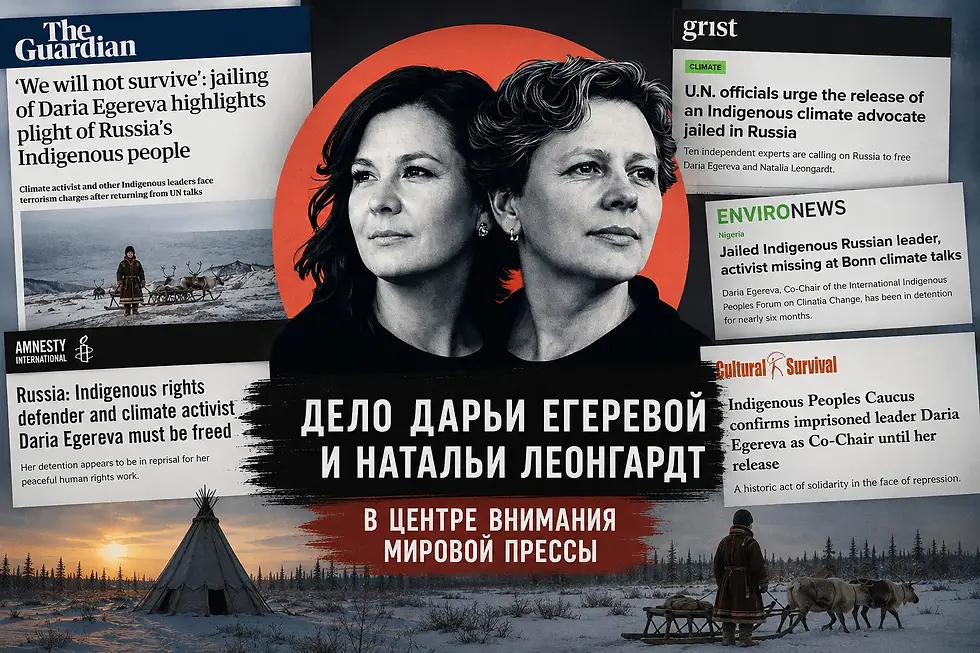
he arrest of Selkup activist Daria Egereva and human rights defender Natalia Leongardt has generated widespread international resonance. Over the past months, dozens of media outlets in Europe, North America, Africa, and the Asia-Pacific region, as well as specialized environmental and human rights publications, have reported on their case.
One of the largest international outlets to draw attention to the situation was the British newspaper The Guardian. In an article titled 'We will not survive': Daria Egereva's detention highlights plight of Russia's Indigenous peoples', journalists note that Egereva's arrest has drawn international attention to the increasing pressure on Russia's Indigenous peoples. The outlet links her case to the climate crisis, industrial development on Indigenous territories, and the shrinking space for civil society.
The American environmental publication Grist has devoted several articles to the case. In June, journalists reported on the appeal by ten UN experts calling for the immediate release of Daria Egereva and Natalia Leongardt. The experts' appeal states: "We are deeply troubled by such an apparent misuse of counter-terrorism and anti-extremism legislation to criminalize peaceful expressions of opinion."
The Nigerian outlet EnviroNews Nigeria published an article titled "Imprisoned Russian Indigenous Leader Missing at Bonn Climate Talks." The authors emphasize that Daria Egereva's absence became one of the most discussed topics among Indigenous representatives at the UN climate session SB64.
International human rights organizations have also reported on the case. Amnesty International USA launched an urgent campaign in support of Daria Egereva, describing her as a "prominent human rights defender and climate activist" and calling her criminal prosecution a possible retribution for years of work protecting Indigenous rights.
Indigenous organizations have paid particular attention to the case. The international organization Cultural Survival called the Indigenous Forum's decision to retain Daria Egereva as co-chair of the International Indigenous Peoples Forum on Climate Change a "historic act of solidarity." The organization's statement reads: "We will not let a prison cell silence a person's voice."
In April and May 2026, the topic of the persecution of Daria Egereva and Natalia Leongardt was also discussed at UN platforms. In a joint appeal, UN special rapporteurs and experts stated that the criminal prosecution of Indigenous representatives for their participation in climate processes and UN mechanisms raises serious concern and may be viewed as a form of repression for international activities.
International observers note that the case of Egereva and Leongardt has become one of the most prominent examples of pressure on Indigenous representatives in Russia and has already extended far beyond the Russian agenda, becoming a subject of discussion in the global climate and human rights community.
"Environmental defenders do not stop at the borders of international treaties. Neither should our solidarity and protection." – Michel Forst, UN Special Rapporteur on the situation of human rights defenders.


Comments