Russia Speaks About Indigenous Rights Abroad. But What Is Happening to the Indigenous Peoples of Russia Itself?


Russia regularly raises the issue of violations of Indigenous rights in other states on international platforms. However, far less often can one hear in official Russian statements about the problems faced by Indigenous peoples within the Russian Federation itself.
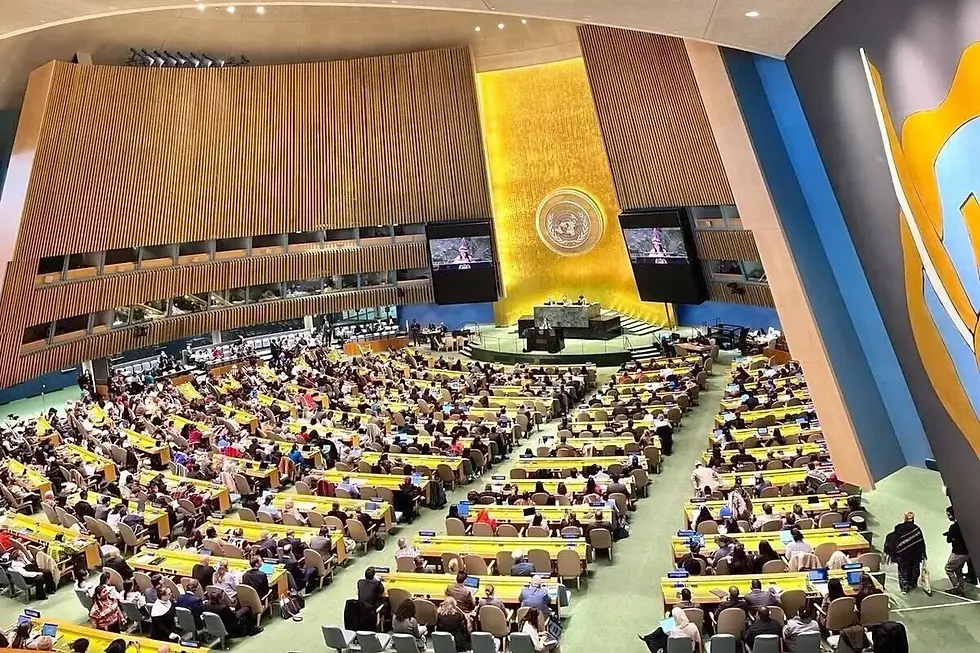
This contrast is especially visible at United Nations platforms.
On 23 September 2026, at the 63rd session of the UN Human Rights Council, the representative of the Russian Federation, Aisa Mukafenova, focused her statement on violations of Indigenous rights in European countries, the United States, Canada and Greenland. The Russian delegation spoke about the consequences of colonial policy, forced sterilization, the removal of children, and the disappearances and killings of Indigenous women and girls.
At the same time, the situation of Indigenous women in Russia itself was not touched upon in the Russian statement.
And this happened at a moment when questions of the persecution of women human rights defenders, of Indigenous access to traditional lands and resources, of the impact of extractive industry, healthcare, education and participation in decision-making had already been presented to UN mechanisms by independent organizations. Particular attention was given to the criminal prosecution of Daria Egereva and Natalia Leongardt.
An obvious contradiction arises: Russia demands that international mechanisms pay attention to violations of Indigenous rights in other states, but the situation in Russia itself remains beyond its own critical assessment.
When other states acknowledge their own responsibility
The contrast is especially striking in the case of California.
On 25 September 2026, Governor of California Gavin Newsom announced the signing of ten bills affecting the rights and interests of Indigenous peoples. They concern the official status of Native American Day, consultation with tribes, education, child protection and public safety.
Bill AB 2115 — the Rowena Mae Ramos Act — contains an official apology from the legislative and judicial branches of California and an acknowledgement of responsibility for the harm and atrocities inflicted on Indigenous peoples by state officials and corresponding policies.
This continues a process begun in 2019, when official apologies to Indigenous peoples were already issued on behalf of the state.
Of course, apologies do not mean that all the problems of US Indigenous peoples are solved. Nor do the new laws mean that. Violations must be discussed regardless of which country they occur in.
But there is a fundamental difference here: state institutions are capable of speaking publicly not only about the violations of others, but also about their own responsibility.
That is precisely the approach Russia lacks with regard to its own Indigenous peoples.
The case of Yana Tannagasheva
The problem is not only that the state does not wish to hear inconvenient information within the country. Pressure also affects those representatives of Russia's Indigenous peoples who try to speak about violations at the international level.
During the 15th session of the UN Expert Mechanism on the Rights of Indigenous Peoples (EMRIP) in Geneva, on 4 July 2022, an incident occurred between Russian diplomat Sergey Chumarev and Yana Tannagasheva, a representative of the Shor people.
This case was seen by Indigenous representatives as an example of a broader problem — pressure on and intimidation of people engaging with international human rights mechanisms.
Four years later, the problem has not disappeared.
On 30 September 2026, a report was published on a new report by the UN Secretary-General devoted to intimidation and reprisals for cooperation with the United Nations. The document presents information on 32 states, including the Russian Federation.
With regard to Russia, the report speaks of the unlawful application of national security provisions and the arbitrary use of legislation on "foreign agents" and "undesirable organizations." The case of Daria Egereva — a human rights defender of the Selkup people, detained after returning from Colombia, where she participated in a UN climate conference — is examined separately.
The report also draws attention to a broader trend of transnational repression: pressure, threats, surveillance and persecution of people already beyond the borders of their states of origin.
Pressure on independent voices continues
I consider it necessary to say this directly.
Pressure on independent sources of information about human rights violations and the rights of Indigenous peoples of Russia continues.
Independent organizations and associations of Indigenous peoples regularly become objects of public attacks, discrediting and accusations by Russian state structures and organizations supporting the official state position.
Instead of an open conversation about problems, attempts are increasingly made to call into question the very legitimacy of independent representatives: whom they represent, whether they have the right to speak on behalf of their peoples, why they turn to international organizations, and why they report information that differs from the official one.
But state registration does not create an Indigenous people.
And the state cannot alone decide which representatives of Indigenous peoples are permitted to speak and which should remain silent.
I fear that this pressure will intensify.
I foresee that Russian state structures, together with organizations controlled by or dependent on the state, including GONGO-type structures, will continue trying to discredit independent Indigenous activists and organizations, restrict their international contacts and push independent voices out of international platforms.
I also do not rule out further involvement of Russian security services, including the FSB, in such pressure on activists.
The purpose of such actions, in my view, is obvious: to achieve a situation in which, at international platforms, the situation of Russia's Indigenous peoples is spoken about mainly by those representatives and organizations whose position is acceptable to the state.
But the state must not choose convenient representatives of Indigenous peoples and pass their voice off as the voice of the peoples themselves.
This becomes especially dangerous when independent representatives are portrayed as enemies of the state, extremists, or people acting against the interests of their own country simply because they report human rights violations to international mechanisms.
The events of recent years give grounds to take such a prospect seriously.
The UN Secretary-General's report published in September 2026 states that persecution of people for engaging with the UN continues, and that Indigenous representatives are among the high-risk groups.
Therefore, the question of protecting independent Indigenous representatives is no longer an abstract discussion about the procedure for participating in the UN.
It is a question of their safety.
The speech that was not delivered
In July 2026, I participated in the 19th session of the UN Expert Mechanism on the Rights of Indigenous Peoples in Geneva.
For item 11 of the agenda — "Future work of the Expert Mechanism, including follow-up to recommendations made in previous studies and consultations" — I prepared a statement.
I was not given the floor on this item. Therefore, this text was not heard in the EMRIP hall. Today I am publishing it in full, without changes.
Draft statement
Item 11
Future work of the Expert Mechanism, including follow-up to recommendations made in previous studies and consultations
Dear Madam Chair,
I speak as a Sámi from the Kola Peninsula and a member of the International Committee of Indigenous Peoples of Russia (ICIPR). A well-known organization among Indigenous peoples around the world. We have our own website, and anyone can familiarize themselves with it. We have a feedback form.
I understand that our work as independent experts does not please some states, and they take all measures to pressure us. I was forced to leave Russia because of threats to my life from the Russian state. And no one can deprive me and my colleagues of our voice and of the right to speak the truth!
The Russian diplomat who spoke today, in this very hall, intimidated a representative of the Shor Indigenous people.
I am speaking about the incident between Russian diplomat Sergey Chumarev and Yana Tannagasheva during the EMRIP session in Geneva, which occurred on 4 July 2022 at the 15th EMRIP session. This incident resonated widely among Indigenous representatives, as it was seen as an example of reprisals — pressure on persons engaging with UN human rights bodies.
The Expert Mechanism has already prepared important studies and recommendations. However, their significance is determined not by the number of published documents, but by whether they lead to real changes in the lives of Indigenous peoples.
Therefore, follow-up work must include regular and transparent assessment of the implementation of recommendations. It is necessary to see which states have actually changed legislation and practice, and which have limited themselves to formal replies.
It is important that Indigenous peoples themselves participate in such assessment, including independent representatives who do not have state registration or official recognition. The state must not alone determine whose voices are considered legitimate. Otherwise, the follow-up mechanism risks receiving convenient reports instead of objective information.
Particular attention must be given to Indigenous peoples who find themselves in conditions of conflict, repression and forced displacement. People who have left their territories and received protection in other countries do not cease to be representatives of their peoples. They retain the right to participate in international processes, to report violations and to make proposals.
I propose creating an accessible mechanism for submitting information on the implementation of previous recommendations, including a protected channel for reports from representatives in exile or under threat of persecution.
The future work of the Expert Mechanism must connect research, Indigenous participation and concrete monitoring of implementation. Recommendations must not remain an archive of good intentions. They must become an instrument of real protection of rights.
In conclusion, I thank the UN Voluntary Fund for Indigenous Peoples for supporting my participation in this session.
To speak even when there is no hope
In Nils Gaup's film "The Kautokeino Rebellion" (Kautokeino-opprøret) there are words that have special meaning for me:
"One must speak the truth even when there is no hope."
The history of Kautokeino is part of the history of my people — the Sámi. But the meaning of these words goes far beyond a single historical event.
For me they mean a simple thing: the right to speak the truth must not depend on whether that truth pleases the state or not.
Russia has the right to speak about violations of Indigenous rights in the USA, Canada, Greenland, Norway or any other state. The international human rights system exists for that purpose as well.
But the same standard must apply to Russia itself.
One cannot demand investigations of violations in other countries and at the same time try to discredit those who report violations within one's own.
One cannot demand that other states hear the voices of Indigenous peoples and at the same time decide which representatives of one's own Indigenous peoples are "correct" and worthy of the international tribune.
One cannot speak about protecting the rights of Indigenous peoples abroad and try to silence independent voices of Russia's Indigenous peoples.
Indigenous peoples have the right to speak for themselves. That is precisely why it is necessary to keep speaking.
Even when the state does not want to hear. Even when they try to punish you for it.
And, returning to the words from the film about Kautokeino — even when it seems that hope is already gone.
Andrey Danilov, Sámi activist and human rights defender, member of the International Committee of Indigenous Peoples of Russia (ICIPR).
I was forced to leave Russia as a result of persecution connected with my human rights work and the protection of Indigenous rights, including in conflicts with state structures and industrial companies.
I currently live in Norway — a state that has granted me international protection.


Comments