How Russia Creates "Official" Indigenous Representatives: A New International Report


The International Committee of Indigenous Peoples of Russia (ICIPR) and the Batani Foundation have published an analytical report, "ICIPR / Batani Foundation Report: Manufacturing Indigenous Legitimacy: The Architecture of Controlled Indigenous Representation and Russia's International Propaganda."
The authors of the study argue that in recent years, an extensive system of state control over the representation of Indigenous small-numbered peoples has been established in Russia. In their view, this is not merely a matter of political influence over individual organizations, but the creation of an entire infrastructure designed to shape and promote state-loyal representatives on the international stage.
The report notes that the Russian Association of Indigenous Peoples of the North, Siberia, and the Far East (RAIPON), previously considered an independent organization, is now integrated into the state system and used to promote Russia's official position on international platforms.
According to the authors, a network of interconnected structures has been formed around RAIPON, including the School of Indigenous Diplomacy, the Project Office for Arctic Development "PORA," the KMNSOYUZ organization, and corporate partners, primarily the company Nornickel. The study claims that this system trains Indigenous representatives for participation in international mechanisms, shapes the expert agenda, and ensures the promotion of state positions within UN structures and other international organizations.
Particular attention is paid to the School of Indigenous Diplomacy, established with the participation of the Russian Ministry of Foreign Affairs, the Federal Agency for Ethnic Affairs, MGIMO University, RAIPON, and Nornickel. The authors believe that the program not only trains young representatives in international affairs but also forms a pool of speakers who appear on UN platforms with narratives aligned with official state policy.
A separate section is devoted to financial ties. Citing their own investigation by Arctida, the authors report that between 2021 and 2025, Nornickel transferred 91.8 million rubles to the KMNSOYUZ organization, accounting for 63% of its budget. According to the report, 21.1 million rubles of these funds were paid to the head of the School of Indigenous Diplomacy, Alexey Tsykarev, for expert and consulting services.
The researchers also analyze the participation of representatives of this system in the work of the UN Expert Mechanism on the Rights of Indigenous Peoples, the UN Permanent Forum on Indigenous Issues, and negotiations on the Convention on Biological Diversity. In their view, this contributes to the displacement of independent Indigenous representatives from Russia in the international agenda.
"What appears to be Indigenous participation is gradually turning into an instrument of state diplomacy. What looks like community representation often reflects the interests of the state and corporations," the report states.
In conclusion, the authors argue that the model created in Russia is not a collection of individual initiatives but a comprehensive system of state management of Indigenous representation. As the report notes, it allows for maintaining the appearance of Indigenous participation in international processes while simultaneously strengthening state control over their representation and limiting the opportunities for independent organizations.
At the same time, the authors emphasize that the research extends far beyond the Russian context. The described model, in their view, demonstrates how states can use controlled organizations, corporate financing, and international mechanisms to create artificial legitimacy and simulate independent Indigenous representation. The report stresses that these findings are significant for the international community, as they help identify vulnerabilities in existing mechanisms for Indigenous participation and contribute to strengthening guarantees for genuine, independent, and rights-based participation in international processes.
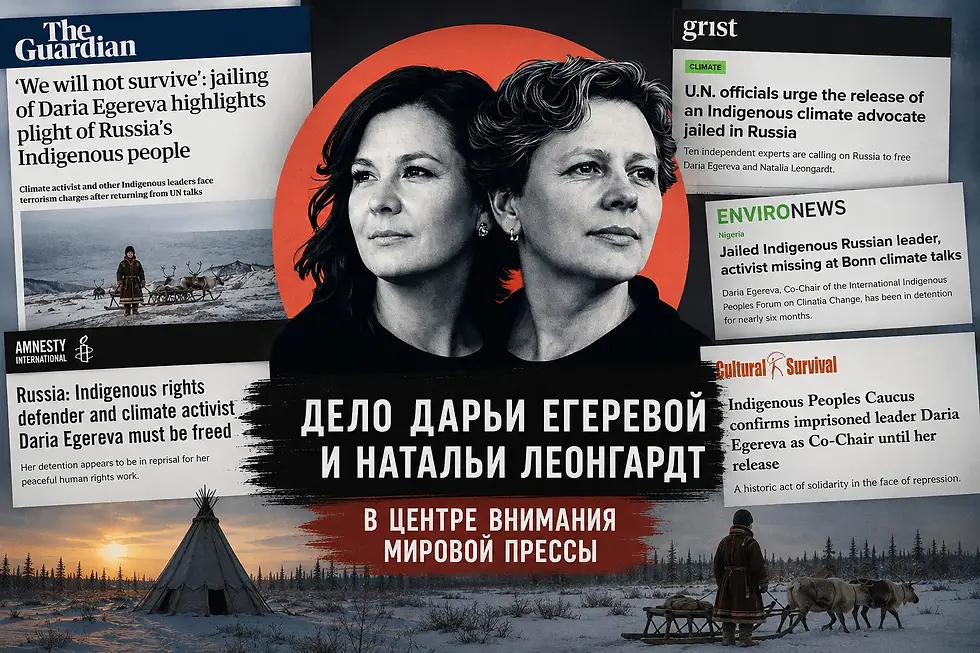
The ICIPR / Batani Foundation Report was officially presented on July 8 during an international online presentation organized by Arctida, the Batani Foundation, and the Indigenous Institute. Participants discussed the study's main findings, as well as the situation of Indigenous peoples in Russia amid increasing pressure on independent activists and organizations.


Comments