Estonia Named Daria Egereva and Natalia Leongardt from the UN General Assembly Rostrum


On 2 October 2026, the names of two Indigenous women human rights defenders from Russia were heard in the Third Committee of the UN General Assembly. Estonia explicitly called their detention arbitrary and the charges unfounded.
This is not a statement by a human rights organization. This is not a social media post or a newspaper column. This is the word of a state, spoken in the main hall of multilateral diplomacy — where every phrase is coordinated, weighed, and entered into the record.
Estonia's Permanent Representative to the UN, Rein Tammsaar, spoke during the general debate of the Third Committee — the body dealing with human rights. Most of his speech was devoted to topics customary for diplomacy: aggression against Ukraine, the situations in Afghanistan, Sudan, and Gaza, digital rights, gender equality, and UN reform.
But there was a passage that means more to the campaign for the release of Daria and Natalia than the rest of the text.
“In Russia, independent journalists, civil society, human rights defenders and ordinary citizens continue to face repression, arbitrary detention and politically motivated prosecutions. As of mid-2026, 21,541 individuals are designated as terrorists or extremists, and at least 5,063 individuals were prosecuted on politically motivated administrative or criminal charges.The long list includes two Indigenous Peoples' representatives – Daria Egereva and Natalia Leongardt – who are arbitrarily detained under unfounded charges of terrorism.”
Tammsaar then added context that usually remains off-screen in news about specific cases:
“Since the start of the unprovoked and unjustified aggression against Ukraine, Russia has designated 172 Indigenous organisations as terrorist, showing systematic targeting of Indigenous communities in Russia.”
This is an important link. Estonia is not talking about “two women in trouble.” It is talking about a system: 172 organizations designated as terrorist, and two specific individuals within that system, named by name.
The case of Daria and Natalia has for many months existed in the space of human rights statements, UN letters, solidarity campaigns and publications in specialized media. All of this is important — but all of it has a ceiling. A human rights organization can say anything, and the Kremlin can ignore it without losing anything.
A state is another matter. When a UN member state takes the floor of the Third Committee and pronounces names, it does three things at once:
It records a fact. The detention is called arbitrary, and the charges unfounded. This is not an assessment by “some experts”; it is the position of a state, entered into the official document of the session.
It sets a precedent. If one country has named them, it will be easier for others to do the same. The first step is always the most expensive.
It deprives the Kremlin of a monopoly on wording. Since 30 September, Peskov has insisted: there are no political prisoners in Russia, only terrorists. Estonia from the UN rostrum said the opposite: these are not terrorists, they are arbitrarily detained people whose charges are unfounded. Two versions now coexist in the same hall.
Here it is important not to deceive ourselves.
Estonia's statement will not free Daria and Natalia. It will not force a Russian court to review the case. It will not open the doors of SIZO-6 or replace the measure of restraint.
It is a signal, not a mechanism.
But it is precisely from such signals that the attention to the case of Daria and Natalia is built, which ultimately makes keeping people behind bars more expensive than releasing them. The appeal of 70 Indigenous organizations and their allies to Vladimir Putin. The joint demand of more than a hundred international organizations for the release of Daria Egereva and Natalia Leongardt. The communication from ten UN special procedures. The Nobel Peace Prize nomination. A thousand signatures delivered to the German Foreign Ministry. And now — the word of a state from the General Assembly rostrum.
While they are in pre-trial detention
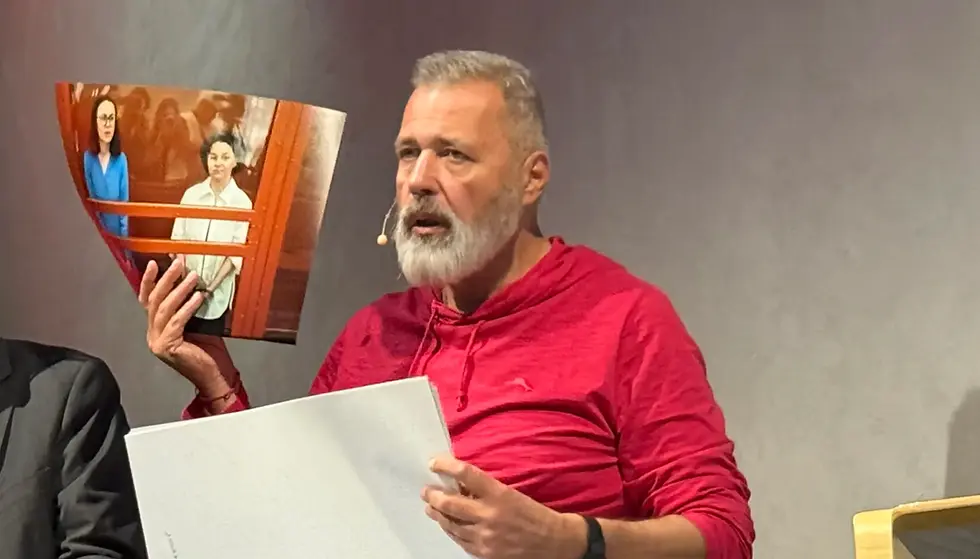
Daria Egereva and Natalia Leongardt have been held in Moscow's SIZO-6 since 17 December 2025. They are charged under Part 2 of Article 205.5 of the Russian Criminal Code — participation in the activities of a “terrorist organization.” They face 10 to 20 years in prison. A Moscow’s Court extended the pre-trial detention until 9 December 2026.
Write them a letter of support
109383, Moscow, Shosseynaya St., 92, FKU SIZO-6 GUFSIN of Russia in Moscow
Egereva Daria Anatolyevna, born 07.04.1977orLeongardt Natalia Allanovna, born 03.03.1968
Electronic letters can be sent using online services:
Free Daria and Natalia!


Comments